

How Salesforce work starts in Provo
Abstrakt Solutions, a Salesforce Consulting Partner, helps builders, software companies and manufacturers in Provo, Orem, Lehi, American Fork and elsewhere in Utah County run their business on Salesforce. Provo is one of our focus markets.
What buyers here usually run into
- 1
A starter CRM that growth has outrun
Software companies often begin with a lightweight sales tool, then discover that trials, usage signals and multi-year enterprise deals no longer fit once larger customers sign on.
- 2
Office and field on different tools
Builders and installation contractors commonly estimate in one system, schedule crews in another and log warranty calls in a third, so nobody sees a full job history.
- 3
Sensitive records with many audiences
Credit unions and medical clinics both hold personal financial or health information, and a Salesforce design has to restrict visibility by role before any marketing automation is switched on.
Budget, team and partner questions
What drives cost
Provo cost drivers split by sector. Software firms spend on migration from a starter CRM, usage-data integration and subscription quoting; builders and installers spend on Field Service, mobile setup and connecting estimating tools. Credit unions and clinics add role-based visibility design before any automation.
Admin or partner
Software companies here often have technical staff who can own Salesforce once it is set up, with a partner for architecture and migration. Builders and trades rarely have that depth and more often use managed services alongside an operations lead.
What buyers ask a partner
SaaS teams should ask for migration references and experience connecting product usage data. Builders should ask for Field Service and warranty references, and every buyer should ask who maintains the org after launch.
The local economy and its biggest industries (4)
| Sector | Share of 2024 GDP | Where Salesforce fits |
|---|---|---|
| Construction Salesforce for construction → | 12.9% | Construction leads the metro’s private output, and state workforce data classifies one of Provo’s top smart-home employers under building equipment contractors. Builders and specialty trades use Salesforce to carry a job from lead and estimate through crew scheduling, change orders and warranty calls. |
| Information Sales Cloud → | 11.3% | Utah County sits on the Silicon Slopes corridor, where subscription software firms need trial funnels, renewal and expansion tracking, and support queues informed by product usage. |
| Professional, scientific, and technical services Salesforce for professional services → | 9.0% | The Mountainland strategy says the region leads Utah on high-tech employment share and on clusters of tech-based knowledge occupations. Consulting, engineering and research firms here use Salesforce to link proposals, project delivery and billing forecasts. |
| Manufacturing Salesforce for manufacturing → | 8.7% | Orem’s community profile lists manufacturing next to technology, and BEA’s county data credits manufacturing with 8.7% of 2024 metro GDP. Industrial producers selling to OEMs want quote approvals, ERP-linked order status and service history on one account. |
Source: U.S. Bureau of Economic Analysis, GDP by county (CAGDP2), 2024, summed to the metro area; private sectors only, excluding real estate and government. “At least” marks sectors where BEA suppresses some county figures.
Regional target sectors named by local economic development groups: Aerospace & Defense, FinTech, Tech (AI, Quantum, Blockchain), Life Sciences & Healthcare, Energy & Minerals, Information Technology (plus Headquarters & Shared Services, Outdoor Products and other EDCUtah industry profiles), Tech industry & startups (named a regional strength), Software and Information Technology (state target industry; CEDS says the MEDD region has a large number of subsectors in it), Financial Services (state target industry; CEDS says the MEDD region has a large number of subsectors in it), Technology, Manufacturing.
Salesforce products that fit Provo (6)
In the order we lead with them here, from the industries above.
Salesforce Sales Cloud
The CRM where sales pipeline lives, when it is built right.
Salesforce Service Cloud
The operating system for modern customer service, case, knowledge, voice, and AI agent assist together.
Salesforce Field Service
Scheduling, dispatch, mobile work orders and parts for teams that work on site.
Salesforce Data 360 (Data Cloud)
Unify customer data into a real-time profile that powers segmentation, analytics, and AI.
Salesforce Revenue Cloud / CPQ
Configure-price-quote, billing, subscription management, and quote-to-cash on Salesforce.
Tableau
Executive analytics, embedded dashboards, and CRM Analytics built on Tableau.
Provo software and construction firms using AI well
Construction leads Provo's 2024 GDP at 12.9%, with information close behind at 11.3%, a mix of builders and software publishers. Software companies usually want AI in support: deflecting how-to questions with product documentation, summarizing tickets for engineers, and triaging trial sign-ups for sales. Builders and trades can use agents for lead intake, warranty claims, and field crew guidance. Many SaaS teams already run their own AI tools, so the useful Salesforce work is connecting agents to trustworthy CRM data and setting limits on what they may change. Human review remains in place for account changes and credits, and professional services firms follow the same rules.
- Ticket summaries for engineers
- Trial sign-up lead triage
- Warranty claim intake for builders
Services buyers here usually need (7)
Salesforce Implementation in Provo
A Salesforce implementation in the Provo-Orem area usually serves one of two very different businesses: construction and installation companies that need jobs, crews and warranty work in one place, or software firms along Silicon Slopes that need trials, renewals and expansion tracked accurately. We design the data model around whichever applies, build in a sandbox, load cleaned data and train each role. Launches are phased, with the core sales or job process first and field, quoting or usage data following.
By industry in Provo
- 1
Construction
Homebuilding and the trades lead Provo-Orem-Lehi output, with construction contributing 12.9% of 2024 GDP by BEA's count. For homebuilders and specialty contractors in Utah County, the implementation decisions that matter are how a job relates to the buyer, the lot or property and the crews working it, and where estimates live. We design those objects first, connect Field Service for scheduling where crews are employed directly, and tie warranty cases to the finished home, so post-closing service never starts from a blank record.
- 2
Information
Software and information companies in Utah County typically sell subscriptions with trials, multi-year terms and expansion across products. An implementation for them must model contracts and renewals carefully, define forecast categories the board will accept and plan how product usage reaches account records. We build pipeline and renewal processes first, then add usage signals through Data 360 (formerly Data Cloud) or a simpler sync once the core definitions are stable. Customer success gets its own views and handoff rules at launch.
- 3
Manufacturing
Orem's community profile names manufacturing alongside technology, and producers in the valley range from industrial materials to consumer products. Manufacturers implementing Salesforce need product catalogs and price books aligned with ERP, quote approvals that reflect margin rules and service history on installed equipment. We settle the product catalog and the ERP link during design, because retrofitting either after go-live forces rework on every quote template and margin report built in the meantime.
Raise before scoping
Model jobs, not just deals
For builders and installers, a signed opportunity is only the start. Plan objects for jobs, properties, phases and warranty items during design, so the Utah County org follows a project from estimate to final walkthrough instead of stopping the moment a contract is signed.
Decide who owns renewals
Software companies should decide whether sales or customer success owns renewals and expansions before configuration begins. The answer shapes opportunity types, forecast categories and compensation reporting, and reversing it after launch unsettles every pipeline report leadership has learned to read.
Launch to one division first
Release to a single sales team, division or product line, gather feedback over a few weeks and adjust before rolling out broadly. For fast-hiring Provo and Lehi companies, that first group becomes the internal champions who coach later waves of new users.
Salesforce Migration in Provo
Many Provo-area migrations begin when a company outgrows the lightweight CRM it adopted early on. Enterprise deals, renewals, partner channels or field operations stop fitting, and data drifts into spreadsheets alongside it. We inventory every source, design the target model for how the business sells now, clean and deduplicate in staging, and run trial loads that users verify. Cutover is planned around quarter-end and busy seasons, with the old system frozen only briefly.
By industry in Provo
- 1
Manufacturing
Utah County factories and plants contributed 8.7% of the metro's 2024 GDP, and Orem's community profile lists manufacturing among the city's strengths. Before Salesforce, a valley producer's dealer list might sit in one place, its quotes in another and its ship-to addresses in the ERP. We match records to ERP customer numbers, standardize product references and migrate open quotes and recent order summaries, so reps start with a complete view and a later ERP integration has clean keys to work with. Distributor agreements come across attached to the right accounts.
- 2
Tech industry & startups
The Mountainland district's economic strategy names the tech industry and startups as a regional strength. Startups leaving starter tools need their early history preserved accurately, especially loss reasons, deal sizes and lead sources, because investors and new sales leaders will analyze them. We map old pipeline stages to new definitions carefully, flag deals that do not fit either scheme and avoid carrying over fields created for one-off experiments that nobody remembers or uses.
- 3
Construction
Builders and contractors often move from spreadsheets, a construction management tool or a homegrown database. Migration involves separating buyers from properties and jobs, bringing warranty history across with the homes it relates to and preserving subcontractor and supplier contacts with their trades. We load recent and open jobs in full, archive older completed work with key details and validate a sample with project managers before cutover, since they know which records look wrong.
Raise before scoping
Redesign rather than replicate
Copying a starter CRM's structure into Salesforce imports its limits. Use the migration to define stages, record types and ownership rules for the business you are becoming, then map old data into that new model rather than bending the new model to fit old habits and workarounds.
Preserve historical stage meanings
If stage definitions change, record how each old stage maps to the new ones and keep the original value in a reference field. That lets Utah County leaders compare historical and current conversion rates honestly after cutover, and it answers investor questions about trends without a spreadsheet reconstruction.
Let record owners check samples
Ask account owners, project managers and customer success leads to inspect a sample of their records in the sandbox before go-live. Their review catches mapping errors that validation scripts miss, such as a renewal assigned to the wrong rep, and builds confidence for launch day across every team.
Salesforce Integration in Provo
Integration needs in the Provo-Orem metro split between software firms and physical businesses. Software companies want billing, subscription and product usage data in Salesforce so renewals and expansion rest on facts; builders, installers and manufacturers want estimating, ERP and scheduling data linked to customer records. We map which system owns each value, choose APIs, middleware or Data 360 (formerly Data Cloud) depending on volume and use, and build monitoring with a named owner so a failed sync is caught the same day.
By industry in Provo
- 1
Information
The information sector generates 11.3% of metro GDP, and the Mountainland district counts 16,680 information jobs across its three counties in 2023. Software firms here depend on connecting product usage, billing and support data to Salesforce. We aggregate usage into meaningful signals, such as active users or feature adoption, rather than streaming raw events, and bring subscription and invoice status from billing so customer success and sales work from the same facts.
- 2
Construction
Homebuilders and contractors typically run estimating software, an accounting or ERP system and scheduling tools alongside Salesforce. Integration lets a signed estimate create a job, sends crew assignments to Field Service and returns completion and warranty information to the customer record. We keep financial detail in accounting, sync only the job status and amounts sales and service need, and document each handoff so the operations team knows which system to correct when something looks wrong.
- 3
FinTech
Fintech appears on the state economic development office's list of targeted industries, and financial technology companies must connect Salesforce with onboarding, compliance and account platforms. We design flows that move application status and account milestones into Salesforce without exposing sensitive financial data broadly, use tokenized identifiers where possible and log every transfer. Sales and success teams gain visibility, and the design holds up under security reviews from bank partners and enterprise customers.
Raise before scoping
Aggregate product usage before loading
Raw product events overwhelm Salesforce storage and API limits. Summarize usage in your data warehouse or Data 360 (formerly Data Cloud), then send account-level metrics such as weekly active users on a schedule, which gives reps useful signals without slowing record pages or crowding out other integrations.
Agree on a shared customer key
Billing, product and CRM systems often identify the same customer differently. Establish one shared identifier early and backfill it into Salesforce, so every Utah County integration matches records reliably instead of creating a fresh duplicate each time a name is spelled differently.
Build for the next tool
Growing companies tend to add tools and acquire businesses that bring their own systems. An integration layer with reusable APIs for customers, products and invoices makes each new connection faster to add and avoids a tangle of point-to-point links nobody on the engineering team wants to maintain.
Salesforce Optimization in Provo
Utah County orgs that need tuning were usually configured for a company a fraction of its current size. A software company's org may have been configured by the founding sales leader and then extended by every hire after; a contractor may have bolted scheduling and warranty tracking onto a sales setup. We review usage, automation and data quality, interview users, then remove clutter, merge overlapping Flows, fix assignment rules and rebuild dashboards on agreed definitions. Changes arrive in small releases tested in a sandbox before anyone sees them.
By industry in Provo
- 1
Professional, scientific, and technical services
Engineering, consulting and research practices account for 9.0% of Provo-Orem-Lehi output under BEA's professional, scientific and technical services heading. Engineering, consulting and research firms here commonly use Salesforce to track proposals, then lose sight of the work once projects start in another tool. Optimization links proposals to projects, removes fields duplicated in the project system and rebuilds utilization and backlog dashboards. Partners can then review pipeline and staffing capacity together in a single weekly meeting instead of reconciling two spreadsheets first.
- 2
Information
Software companies here often find that renewal forecasts disagree with finance, partly because opportunity types, close dates and contract terms were entered inconsistently over the years. We standardize those fields, automate renewal opportunity creation from contracts and rebuild the renewal and expansion dashboards customer success uses. Product usage summaries can be added to account pages where they help prioritize outreach, instead of being scattered across many custom fields no one maintains.
- 3
Construction
Builders and specialty contractors may keep leads and contracts in Salesforce but use separate tools for scheduling and warranty, with staff re-keying data between them. Optimization identifies where double entry happens, moves steps into Salesforce or a proper integration, and simplifies mobile layouts so superintendents and crew leads can update jobs quickly from site. Dashboards then show job progress, change orders and warranty volume by community or trade, which is how Utah County builders tend to run weekly production meetings.
Raise before scoping
Fix the forecast first
In fast-growing Utah County companies, the forecast is usually the report leadership watches most closely. Repairing stages, close dates and forecast categories before anything else earns credibility for the rest of the optimization program and gives sponsors a visible early result.
Trim mobile layouts for field users
Crews, installers and field sales reps use Salesforce on their phones. Cut mobile layouts down to the fields they actually touch, add quick actions for status updates and photos, and test on the phones they carry to job sites, not only on office monitors.
Replace legacy automation object by object
Older workflow rules and Process Builder automation should move to Flow one object at a time, with side-by-side testing. The exercise also exposes obsolete logic from earlier stages of the business, such as rules for a discontinued plan or old territory, that can simply be retired rather than rebuilt.
Salesforce Health Checks in Provo
Utah County companies usually request a health check at an inflection point: a funding round, a new sales leader, an admin departure, an acquisition or a plan to add AI. Fast growth tends to leave permissions granted broadly, automation stacked on automation and integrations nobody fully documented. We examine security, sharing, integrations, automation, code, data quality and adoption, interview key users and deliver ranked findings with effort estimates, so leadership knows what to fix before the next stage of growth.
By industry in Provo
- 1
Software and Information Technology
Software and IT is a state target industry, and the Mountainland strategy says many of its subsectors are present in the region. When a Silicon Slopes vendor pursues a large enterprise account, procurement will eventually ask pointed questions about the vendor's own CRM. A health check supplies the answers: authentication policies, connected apps, export permissions, integration users and audit settings. It also measures technical debt, including unused fields, abandoned packages and duplicated automation that slows the org.
- 2
FinTech
Financial technology firms answer to bank partners, auditors and regulators about customer data. The review focuses on who can view or export financial information, whether sensitive fields are encrypted or masked appropriately, how integration credentials are stored and whether field history and event logs capture enough to reconstruct access. Findings map to remediation steps a compliance team can track to completion, with owners and target dates set in the readout meeting.
- 3
Construction
Builders and contractors rarely think of their CRM as a security risk, yet their orgs hold homeowner contact details, addresses and sometimes financing information. A health check confirms that subcontractor and partner access is limited, reviews mobile device settings and checks data quality on job and warranty records. It also flags record-triggered automation that fails silently, which can leave a homeowner's warranty request sitting unassigned for weeks without anyone noticing.
Raise before scoping
Check sandbox data exposure
Growing companies often refresh full sandboxes with production data and grant broad sandbox access to contractors. Confirm sensitive fields such as homeowner, patient or account data are masked in non-production environments and that access matches who genuinely needs it for current work.
Review assignment and routing logic
Lead and case assignment rules often reflect old territories and team structures. Verify that routing still sends work to active users and current teams after each reorganization, since misrouted leads cost Utah County sales teams opportunities without anyone noticing until quarter-end.
Rank fixes by business impact
Technical findings mean more to leadership when tied to consequences such as delayed renewals, lost leads or audit exposure. Ask for findings ranked by business impact as well as technical severity, which makes funding the fixes a far easier conversation.
Salesforce Managed Services in Provo
Managed services in Utah County usually supports growth rather than maintenance. Software firms add products, territories and customer success teams; builders and installers add crews, regions and warranty processes. Each change touches Salesforce. We keep a ranked backlog with your leaders, deliver enhancements in planned releases, handle user and permission changes as people join or move, test Salesforce's seasonal releases and monitor integrations. Your internal admin, if you have one, gains a team behind them instead of carrying every request alone.
By industry in Provo
- 1
Information
Subscription software companies in the valley adjust pricing, packaging and territories often, and every adjustment ripples into Salesforce fields, quote templates and reports. A managed team keeps those changes orderly: new products added consistently, territory and assignment rules updated on schedule and renewal reports verified after each change. We also maintain the connections that feed product usage into account records, because stale usage data quickly misleads customer success managers about which accounts are healthy.
- 2
Construction
Builders and contractors grow by adding communities, regions or trades, and their Salesforce setup must keep pace. Ongoing work includes new service territories and crews in Field Service, updated inspection checklists, warranty categories as new home plans launch and dashboards for superintendents. We schedule changes away from the weeks when crews are busiest, so nobody on a Utah County job site is learning a rearranged mobile screen while trying to close out a punch list.
- 3
Life Sciences & Healthcare
The Utah Governor's Office of Economic Opportunity lists life sciences and healthcare among its statewide targeted industries, and clinics, device makers and health services firms in the valley need Salesforce changes handled with privacy in mind. Managed services for them includes regular access reviews, careful handling of fields that carry health information, release testing on patient or customer communication flows, and documentation that supports compliance questions whenever they come up.
Raise before scoping
Budget hours around growth events
Plan managed hours around your company calendar rather than an even monthly average. Product launches, territory realignments and hiring waves create predictable spikes in Salesforce work, and scheduling them ahead avoids rushed changes that later need cleanup by the same team that made them.
Check integrations before each release
Fast-growing Utah County companies often connect billing, product analytics and scheduling tools to Salesforce. Every field rename or automation change should be tested against those integrations before release, since a broken sync is much harder to notice than a broken screen.
Document changes as they happen
Rapid change erodes shared knowledge. Record the purpose of each new field, automation and permission set when it is added, so new admins, auditors or a future partner can understand the Provo org without interviewing everyone who has touched it.
Salesforce Implementation Rescue in Provo
In Utah County, a stalled Salesforce build usually means the company kept evolving while the design stayed frozen at its kickoff assumptions. A software company adds products or a partner channel mid-project, or a contractor's field operations turn out to be more complex than the sales-focused design assumed. We triage the org, scope documents, backlog and user feedback, then decide what to keep, fix or rebuild. Recovery is phased, restoring daily sales, service or field processes first and adding deferred scope afterward.
By industry in Provo
- 1
Construction
One failure pattern we look for among builders and installers is a Salesforce launch that handled sales but not the job itself, so scheduling, change orders and warranty work stayed in other tools. Recovery completes the job model, connects Field Service or the existing scheduling system and moves warranty cases onto the homes and buyers they belong to. Superintendents and crew leads get simplified mobile layouts they can use from the site.
- 2
Information
Software firms sometimes reach go-live with pipeline tracking in place but renewals, contracts and product usage never connected. Finance and customer success keep their own spreadsheets of renewal dates, and the two forecasts rarely agree. Rescue finishes the contract and renewal model, repairs or replaces half-built integrations with billing and product systems, and rebuilds forecast reporting so executives review one set of numbers. We document definitions so the same split does not reappear.
- 3
Manufacturing
Manufacturers can end up with a quoting implementation stuck halfway, where product rules in Revenue Cloud are incomplete and reps have gone back to spreadsheets. We review the product catalog, pricing logic and approval rules, salvage what works and simplify bundle and discount rules that were overengineered for edge cases. Once quotes produce correct results, we retrain reps and connect accepted quotes to ERP orders, completing the process the original project promised but never delivered.
Raise before scoping
Recheck scope against today's business
A valley company that has added products, crews or a sales channel since kickoff is probably working from stale requirements. Validate scope with current leaders and the heaviest users before resuming work, so recovery delivers what the Provo-area business needs now rather than what was specified long ago.
Assign an internal product owner
Recovered orgs drift again without an internal owner. Name someone who understands sales and operations, protect time in their week for decisions and involve them in every sprint review, so knowledge stays inside the company once the rescue work ends.
Show progress to skeptical users
Staff who gave up on Salesforce need to hear what is changing. Share short release notes, demonstrate fixes in team meetings and invite feedback through a simple request form, so Utah County teams see the system improving and start relying on it again.
Industry plays in Provo (4)
Salesforce for Provo Construction Firms
Construction in Utah County includes production homebuilders, commercial general contractors and the specialty trades that serve both. Salesforce helps each one differently. Builders need buyer tracking from first visit through selections, closing and warranty. General contractors need bid pipelines, owner and architect relationships and preconstruction handoffs. Trades need estimating, scheduling and service calls tied to the same customer. We design around the business model you actually run and connect Salesforce to your estimating and accounting tools.
In the Provo-Orem-Lehi metro, construction is the single largest private sector: the Bureau of Economic Analysis attributes 12.9% of 2024 GDP to it, ahead of information at 11.3%. The Mountainland Economic Development District's regional strategy for Summit, Utah and Wasatch counties names the tech industry and startups as a regional strength, and the City of Orem's community profile highlights technology and manufacturing. For builders, that means commercial clients with tech-sector timelines and homebuyers who expect a digital, well-organized sales experience from first inquiry onward.
Use cases to open with
- 1
Homebuyer journey to closing
Production and semi-custom builders follow a buyer from a model-home visit through lot selection, contract, design center appointments and closing, sometimes over a long build. Sales Cloud with community, lot and plan records, plus Marketing Cloud nurture for prospects not yet ready to commit, keeps sales agents organized across several communities at once. Selection changes flow to purchasing and scheduling systems so the construction team builds exactly what the buyer chose and signed.
- 2
Commercial bid pipeline
General contractors pursue projects through invitations to bid, prequalification packages and negotiated work with repeat owners. Sales Cloud can track each pursuit by project type, delivery method, estimated value and bid date, along with the owners, architects and subcontractors involved in it. Leadership sees hit rates by market segment and delivery method, and can decide which pursuits deserve preconstruction effort before scarce estimators are assigned to them.
- 3
Warranty and service requests
After move-in or turnover, homeowners and building owners report issues that need inspection, scheduling and follow-up by the right trade partner. Service Cloud cases with photos, an Experience Cloud portal for submitting requests, and Field Service for scheduling technicians give warranty teams a complete history by home or building. Recurring patterns in claims, such as the same defect across one floor plan, feed back into construction quality reviews.
Raise before scoping
Community, lot and plan data
Builders need a data model that reflects communities, phases, lots, plans and options. Getting that structure right before launch matters more than any dashboard, and it should match how your purchasing and scheduling systems already identify homes to keep integration simple.
Estimating stays in estimating
Estimating and takeoff tools are specialized, and Salesforce should not try to replace them. Pass approved estimate totals and key assumptions into opportunities through integration, and keep line-item detail where estimators already work, so pipeline value reflects real numbers rather than rough guesses entered by sales.
Field crews on mobile
Superintendents, warranty technicians and trade crews work from trucks and job sites, not desks. Mobile layouts, photo capture and offline access determine whether they use the system at all, so pilot with field staff before a full rollout and keep every form as short as the process allows.
Salesforce for Provo Professional Services Firms
Professional services firms in Utah County often serve fast-growing technology clients whose needs change quickly. Salesforce should help partners and practice leaders see which engagements are coming, which clients are expanding and where capacity is tight. We set up pipelines by service line, statement-of-work tracking and retainer renewals, connect Salesforce to your PSA or accounting system for utilization and billing data, and give leadership a forecast that combines new business with recurring work.
Behind construction and information, professional, scientific and technical services is the third-largest private sector in Utah County's metro, with 9% of 2024 output according to the Bureau of Economic Analysis. The Mountainland Economic Development District's regional strategy calls the tech industry and startups a regional strength and notes that the Information sector in its three counties had a location quotient of 2.32 in 2023. Utah's statewide targeted industries include financial services and software. For firms that provide legal, accounting, engineering, marketing and consulting services, that concentration of technology companies is the core client base.
Use cases to open with
- 1
Engagement pipeline by practice
Firms with audit, advisory, engineering or creative practices need pipelines that reflect how each practice actually sells and prices its work. Sales Cloud record types and stages per practice, with shared client accounts, let partners see relationships that cross practice lines. Leadership can forecast by practice and client segment, and quickly spot clients buying only one service when another practice could solve a problem they have already mentioned.
- 2
Statements of work and pricing
Fixed-fee, time-and-materials and retainer engagements each need different pricing and approval rules, and inconsistent statements of work cause disputes later. Revenue Cloud or CPQ can assemble statements of work from standard service components and rate cards, route discounts for approval and generate documents for signature. Won work passes to the PSA or project system with scope, budget and staffing assumptions intact, so delivery starts from the same facts sales agreed to.
- 3
Startup and growth-stage clients
Technology clients change fast: a seed-stage company becomes a scale-up, raises capital, hires executives and suddenly needs audit, legal or engineering services it never bought before. Tracking funding events, leadership changes and key contacts in Salesforce, with Marketing Cloud for thought leadership and event invitations, helps firms stay relevant as clients grow rather than losing them to larger competitors at the moment the work becomes valuable.
Raise before scoping
Utilization and billing data
Partners want to see utilization, realization and billing next to pipeline. That data lives in PSA and accounting systems, so plan integration or a reporting layer such as Tableau early, and agree on definitions before building dashboards anyone will rely on.
Independence and conflict checks
Accounting and legal practices have to clear independence and conflict questions before an engagement letter goes out. Salesforce can capture the relationship data that supports those checks, but the formal review usually stays in a dedicated system, and the handoff between the two needs a clear owner and an audit trail.
Adoption that starts with partners
Partners own the relationships and often resist logging activity. Keep the system directly useful to them, with meeting preparation, client summaries and automatic email capture, rather than treating CRM as a reporting obligation. Partners who find their own prep time shrinking become the system's best advocates.
Salesforce for Provo Manufacturers
Manufacturers in the Provo-Orem area often compete for talent and attention with software companies, and their customers bring software-era expectations: quick answers, online ordering and products that report back. Salesforce helps a hardware business meet that bar. Sales Cloud and CPQ manage dealers and direct accounts, Service Cloud handles warranty claims and registrations, and Data 360 (formerly Data Cloud) can bring device or usage data into the account record. Stock levels, standard costs and shipping still come from the ERP, untouched.
At 8.7% of 2024 metro GDP, manufacturing ranks fourth among private sectors in the Provo-Orem-Lehi area by the BEA's county data, behind construction at 12.9% and information at 11.3%. No Utah County-only target list exists, but the City of Orem's community profile names manufacturing alongside technology. The Mountainland regional strategy says the three-county area holds many subsectors of the state's target industries, which include advanced manufacturing and aerospace and defense. EDCUtah also publishes an outdoor products industry profile, a statewide category that fits many Utah County product brands.
Use cases to open with
- 1
Dealer and direct channels
Outdoor and consumer-hardware brands frequently sell through specialty dealers, big retailers and their own website at once. Sales Cloud tracks dealer accounts, programs and sell-in, while CPQ enforces pricing tiers and minimum order rules. Marketing and sales see where direct-to-consumer demand overlaps dealer territory, so channel conflicts get addressed with data rather than anecdotes during the annual dealer meeting, and reps can show each dealer how its own sell-through compares with the region.
- 2
Warranty and product registration
Every registered product is a service relationship waiting to happen. Service Cloud connects registrations, serial numbers and purchase data so agents can verify coverage in seconds, process a warranty claim, and ship a replacement part. Claim trends by model and production batch go back to engineering, turning warranty data into design feedback instead of a cost line nobody examines, and repeat claims from a single retailer or region become visible early.
- 3
Subscriptions on connected products
Hardware that ships with an app, a data plan or a software subscription creates recurring revenue and renewal risk. Revenue Cloud can manage subscription terms and renewals, and Data 360 (formerly Data Cloud) can pull usage signals into the customer record. Account teams see which customers are active, which devices have gone silent for weeks and which renewals need attention before the contract lapses, giving customer success a list to work each Monday.
Raise before scoping
Hardware and software data
When a product combines a physical unit with software, the ERP, the app platform and billing each know a piece of the customer. Decide which system owns the device, the subscription and the invoice, and plan identity matching before building dashboards that depend on all three.
Hiring against software firms
Utah County manufacturers compete with nearby tech campuses for admins and developers. Plan for a lean internal team, favor standard features over custom code, and document everything, so the org survives turnover. Managed services can fill specialized gaps without adding permanent headcount.
Dealer data sharing
Dealers want leads, warranty status and co-op information, but not visibility into each other's accounts. If an Experience Cloud portal is planned, design sharing rules and dealer hierarchies carefully, and pilot with a few trusted dealers before the full network gets access.
Salesforce for Provo Health and Life Sciences
Health and life sciences in the Provo-Orem area often looks like a technology business with clinical obligations: multi-location clinics that compete on convenience, digital health startups selling to employers and providers, and life-sciences firms building direct relationships with clinicians. Salesforce can handle patient access, provider and employer sales, and support in one org. The critical design step is deciding which data qualifies as protected health information, how it is secured, and what stays in the EHR.
Health care is not among the five largest private sectors in the Provo-Orem-Lehi metro in the BEA's 2024 county data, which construction, information, professional services, manufacturing and retail lead. It shows up instead through Utah's statewide target industry of life sciences and healthcare, and the Mountainland regional strategy notes the area holds many subsectors of that target. The information sector's weight matters too: the Mountainland region counted 16,680 information jobs in 2023, with a location quotient of 2.32, which helps explain why many local health ventures are software-first.
Use cases to open with
- 1
Clinic access and scheduling help
Growing clinic groups field calls about appointments, insurance, billing and results across several locations. Service Cloud gives a central access team one view of each patient's open requests, with privacy controls and links to the EHR. Agentforce can answer routine questions such as hours, locations, accepted insurance and preparation steps, and hand anything clinical to staff with the conversation attached, so nurses are not tied up confirming parking directions.
- 2
Employer and provider sales
Digital health companies often sell to employers, health plans and provider groups rather than patients directly. Sales Cloud tracks those pursuits with pilots, contract terms and implementation milestones, while CPQ standardizes per-member or per-seat pricing. Customer success teams see onboarding progress, eligible-member enrollment and engagement metrics for each employer, so renewals are argued with evidence rather than optimism, and expansion conversations start with the accounts showing real use.
- 3
Clinician engagement for life sciences
Device and life-sciences firms need to know which clinicians have trialed a product, attended training or requested samples. Salesforce can track those interactions, route inquiries to medical or sales staff as appropriate, and keep compliant records of materials shared. Marketing Cloud sends approved education content, and engagement data helps field teams plan visits around the clinicians and practices that are actually reading, attending or asking follow-up questions.
Raise before scoping
Where PHI actually lives
Startups sometimes pour everything into the CRM early. Decide which fields are protected health information, sign a business associate agreement with Salesforce when PHI is stored, apply field-level security and encryption, and keep clinical detail in the EHR with links rather than copies.
Growth outrunning the design
Fast-growing health ventures often inherit a lightweight CRM setup that no longer fits once enterprise customers sign. Plan a data model that separates patients, members, employers and providers from the start, so later expansion does not require rebuilding objects and reports.
Clinical staff adoption
Nurses and medical assistants already live in the EHR. Salesforce should ask little of them: surface only what they need for outreach or follow-up, integrate context from the EHR, and test workflows with clinical staff before launch rather than after complaints arrive.
Case studies to send (3)
From the industries this market leans on. Client names are anonymized and these projects are not specific to Provo.
The Provo Salesforce market brief, Q4 2026
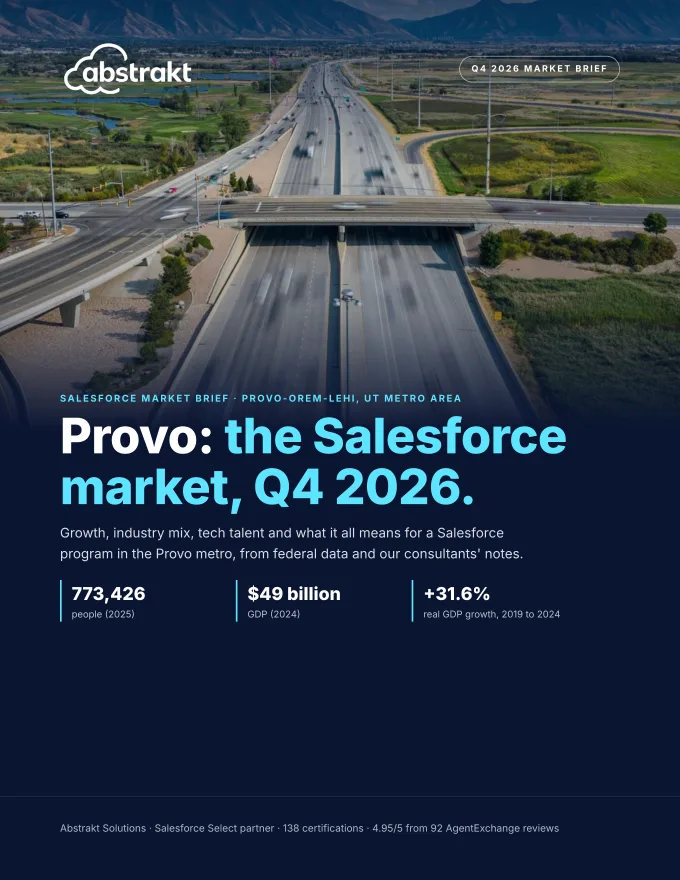
A free 24-page PDF with Provo's growth ranked against 100 metros, its industry mix, tech wages and nearby markets. It is offered on the public Provo page; send your customer there or get a copy for your own prep.
Get the Provo brief →Co-sell with Abstrakt in Provo
Working a Provo account? Bring in a named consultant for discovery, scoping or a health check. We reply within 4 business hours.