

How Salesforce work starts in Ogden
In Ogden and throughout Weber and Davis counties, Abstrakt Solutions works as a Salesforce Consulting Partner for manufacturers, builders and health organizations. Ogden is one of our focus markets.
What buyers here usually run into
- 1
Selling into defense programs
Suppliers to military and defense customers usually work through long contracts and formal requirements, so the CRM has to track programs and task orders, not just deals.
- 2
Consumer brands with many channels
Outdoor and consumer-products companies commonly sell through dealers, large retailers and their own websites, which splits customer data unless Salesforce ties it together.
- 3
Lean teams, very large customers
Many regional suppliers run small sales and support teams while serving very large customers, so automation and trustworthy reporting matter more than extra features.
Budget, team and partner questions
What drives cost
Ogden costs depend on how programs and task orders are modeled for defense suppliers, quality and ERP integration, and how many sales channels a consumer brand needs to unify. Consolidating manuals, parts catalogs and serial-number records before any AI work is often an overlooked line item.
Admin or partner
Regional suppliers here often run lean, with no one dedicated to Salesforce. Managed services usually fits better than a first hire until the org is stable; larger primes tend to have internal teams and use partners for specific rollouts.
What buyers ask a partner
Ask defense suppliers' questions directly: how the partner restricts sharing for sensitive pursuits and what data they would keep out of the org. Consumer brands should ask for dealer portal and multi-channel references.
The local economy and its biggest industries (4)
| Sector | Share of 2024 GDP | Where Salesforce fits |
|---|---|---|
| Manufacturing Salesforce for manufacturing → | 17.8% | Aerospace, defense and advanced-materials manufacturers clustered around the Davis County air base, prime contractors among them, run long programs with configured products and quality records that need to connect to sales and service. |
| Retail trade Salesforce for retail & consumer goods → | 8.1% | Retailers and outdoor-products brands, one of Ogden City’s target industries, sell through stores, dealers and online channels and need order, customer and service data kept together. |
| Construction Salesforce for construction → | 7.2% | Contractors working across Weber and Davis counties manage bids, subcontractors and crews, work that Field Service and CPQ estimating can bring into one view. |
| Health care and social assistance Salesforce for health & life sciences → | 6.6% | With a large hospital network and a medical-products plant among Northern Utah’s big employers, providers and care organizations need patient outreach, referrals and service designed with privacy controls. |
Source: U.S. Bureau of Economic Analysis, GDP by county (CAGDP2), 2024, summed to the metro area; private sectors only, excluding real estate and government. “At least” marks sectors where BEA suppresses some county figures.
Regional target sectors named by local economic development groups: Aerospace & Defense, Outdoor Products, Life Sciences, Software & Technology, Advanced Materials & Manufacturing.
Salesforce products that fit Ogden (6)
In the order we lead with them here, from the industries above.
Salesforce Sales Cloud
The CRM where sales pipeline lives, when it is built right.
Salesforce Revenue Cloud / CPQ
Configure-price-quote, billing, subscription management, and quote-to-cash on Salesforce.
Salesforce Service Cloud
The operating system for modern customer service, case, knowledge, voice, and AI agent assist together.
Salesforce Experience Cloud
Customer, partner, and employee portals built on Salesforce.
Salesforce Marketing Cloud
Cross-channel marketing, email, mobile, journey, and Data 360-powered personalization at scale.
Salesforce Field Service
Scheduling, dispatch, mobile work orders and parts for teams that work on site.
Manufacturing-first AI priorities for Ogden companies
Manufacturing dominates Ogden's private economy, 17.8% of metro GDP in 2024, and the region targets aerospace, defense, outdoor products and advanced materials. For makers, AI earns its place in service and field operations: summarizing warranty cases, drafting dealer replies from product documentation, and giving technicians an assistant that pulls asset history onto the work order. Outdoor and consumer brands, overlapping with retail at 8.1%, can offer self-service for sizing, returns and repairs. Construction firms, 7.2%, can triage bids. The honest caveat is that manuals, parts catalogs and serial-number records usually need consolidation before any agent can answer accurately.
- Warranty case summaries for makers
- Asset history on technician work orders
- Sizing, returns and repair self-service
Services buyers here usually need (7)
Salesforce Implementation in Ogden
Implementation in the Ogden area usually means designing Salesforce for a lean team with outsized customers: a supplier with a small staff selling into a defense program, an outdoor brand with a large dealer network, a contractor bidding against much larger firms. We keep the data model close to standard objects, add only the custom records the business truly needs, and automate the repetitive work that small teams cannot absorb. Releases are phased, with discovery workshops and go-live planned for teams in both Weber and Davis counties.
By industry in Ogden
- 1
Aerospace & Defense
Aerospace and defense is on Ogden City's list of target industries, and the city sits two miles from a major Air Force base in Davis County. Suppliers here sell through programs, task orders and prime contractors rather than simple deals. An implementation for them models programs and contract periods as records in their own right, relates pursuits to both the prime and the government customer, and keeps sensitive technical content out of the CRM entirely. Leadership gets a backlog and recompete view from the first release.
- 2
Outdoor Products
Outdoor products is one of the city's target industries, and brands here typically sell through independent dealers, large retailers and their own online stores at once. Implementation starts with the account model: dealers, retail buyers and direct consumers each need a different structure. We usually launch Sales Cloud for dealer and retail accounts first, then add Service Cloud for warranty and parts questions, and plan the dealer portal once account data is reliable enough to expose externally.
- 3
Construction
Construction produces about 7.2% of 2024 metro GDP, and contractors across Weber and Davis counties keep bids, subcontractor contacts and crew schedules in separate tools. A Salesforce implementation for them tracks each bid from invitation to award, relates general contractors, owners and architects to every job, and hands won work to Field Service for scheduling. Estimating stays in the tool estimators already trust, with totals and status flowing into the opportunity.
Raise before scoping
Size the org to the team
Many Northern Utah suppliers run sales and support with a handful of people. Every required field and approval step costs them time, so we design the smallest configuration that answers leadership's questions and add complexity only when users ask for it after launch.
Match hypercare to your business hours
Workshops and user testing are timed around shift starts, and hypercare coverage for the first week follows your business hours.
Decide who owns the customer record
Brands selling through dealers, retailers and e-commerce often have three systems each claiming the customer. Settle which one is the master for accounts, contacts and addresses before building, or every later channel and integration inherits the conflict. Document the matching rule that links a dealer sale to a consumer.
Salesforce Health Checks in Ogden
An Ogden health check is often requested by a defense supplier answering a customer's security questions, a provider confirming patient data is contained, or a company planning AI features. The review covers four areas: access and sharing, including integration accounts and connected apps; technical debt in automation, code and installed packages; data quality on accounts, contacts and cases; and reporting accuracy. Each finding comes with its evidence, a risk rating and a recommended fix, and we walk your team and leadership through the results.
By industry in Ogden
- 1
Aerospace & Defense
Suppliers supporting programs at the nearby Air Force base and its prime contractors face growing questions about how they protect customer information. A health check documents the Salesforce side: who holds administrative rights, how authentication and sessions are configured, which connected apps have access and whether any attachments or notes contain content that belongs in a controlled repository instead. The results give security leads concrete evidence for customer assessments, along with a list of dormant logins to disable.
- 2
Health care and social assistance
Providers make up about 6.6% of Ogden's 2024 economic output, and a hospital network appears on the regional alliance's list of big employment centers. Providers using Salesforce need to know that patient information is visible only to the roles that require it. We review sharing, report and export permissions on those records, check portal and community access and look for clinical details stored in free-text fields where they were never meant to be.
- 3
Life Sciences
For device and life sciences firms, the review concentrates on records their quality system depends on. A health check examines whether automation on those records behaves consistently, whether field history captures the changes auditors expect and whether validation rules still reflect current procedures. It also flags unused packages and custom code that complicate validated changes, so the next quality review goes more smoothly. Findings reference the specific records and settings involved.
Raise before scoping
Check integrations and tokens
Integration users and connected apps often hold broader rights than their feeds need, and tokens may never expire. Include every one in the review, confirm it is still used and owned and reduce its access. Unexplained connections should be removed.
Clean data before AI pilots
An AI agent answers from whatever the org already contains and whatever the running user may open. Duplicate accounts, outdated knowledge and loose sharing lead to wrong answers or exposed data. Reviewing first gives the pilot a cleaner starting point.
Write findings for leadership
Technical detail matters to admins, but owners of small companies need a short summary: what is at risk, what fixing it involves and what happens if it waits. Presenting both levels speeds the decisions that get remediation funded and scheduled.
Salesforce Integration in Ogden
Integration projects in the Ogden area mostly connect Salesforce to an ERP for pricing, orders and inventory, to an e-commerce platform for direct sales, or to clinical and scheduling systems for providers. We start by agreeing which system owns each customer, product and order field, then choose the right method for each flow: real-time APIs, scheduled syncs or middleware. Failed records land in a log with an email to whoever owns that feed, and nothing goes live until a batch of genuine transactions has passed through the sandbox.
By industry in Ogden
- 1
Advanced Materials & Manufacturing
Advanced materials and manufacturing is one of Ogden City's target industries, and the city cites local workforce strength in engineering and advanced materials. These manufacturers produce specified, often custom products where quotes depend on ERP costs and lead times. The integration feeds part masters and cost-based pricing to Revenue Cloud, turns signed quotes into ERP sales orders automatically, and posts production and ship dates back where the rep can see them.
- 2
Outdoor Products
Outdoor-products brands usually need three connections: the ERP for dealer orders and inventory, the e-commerce platform for direct sales, and a warranty or returns process. Integration brings both order streams onto the same accounts and contacts in Salesforce, so service agents see a consumer's online purchase and the dealer who sold a unit in one history. Dealer portals built on Experience Cloud can then show inventory and order status from that same data.
- 3
Health care and social assistance
Clinics and care agencies in Weber and Davis counties want their call-center and outreach staff to see appointments and coverage status, not the chart. We integrate only the identifiers, appointment details and status fields each role requires, keep diagnoses in the medical record system, and restrict the integration user to exactly the data its feed carries. Each flow is documented so privacy officers can review what crosses the boundary, and access logs are kept for the integration account.
Raise before scoping
Choose one master per record
When dealer orders come from the ERP and consumer orders from an online store, customer records can multiply fast. Decide which system creates accounts and contacts and how others match to them, before any integration is built, or duplicates start on the first day.
Match sync speed to need
Dealer-portal inventory may justify instant updates; invoice history rarely does. Choosing the right timing per flow keeps costs and API usage down and makes failures easier to diagnose when they do occur. Revisit the choice when a new channel or portal is added.
Plan who watches the logs
Small companies rarely have an integration specialist on staff. Decide at the outset who receives failure alerts and what they do next, whether an internal IT generalist with a runbook or a managed-services team that monitors the integrations for you.
Salesforce Optimization in Ogden
Ogden-area companies usually come to optimization with an org built quickly by a small team and never revisited. Retailers keep service notes outside Salesforce, software firms have pipeline stages nobody agrees on, and contractors track bids in spreadsheets beside the CRM. Our review starts with evidence: who logs in and what they touch, which flows and triggers fire on accounts and opportunities, and where dashboards part ways with the books. Then we cut clutter, merge overlapping automation, rebuild the reports leaders depend on and retrain each team in short, practical sessions.
By industry in Ogden
- 1
Retail trade
At about 8.1% of 2024 GDP, retail gives Ogden a bigger consumer-facing base than many manufacturing-led metros. Retailers and consumer brands often have Service Cloud orgs where agents still copy order details from another screen, macros are outdated and case reasons are too vague to report on. Optimization streamlines the agent console, refreshes quick-text and knowledge, tightens case categories and builds a weekly view of contact drivers so merchandising can see which products generate the most questions.
- 2
Software & Technology
Software and technology companies, supported locally by a startup co-working space the city cites, tend to adopt Salesforce early and customize it heavily. By the second or third year, opportunity stages have multiplied, lead routing is patched together and renewal forecasting lives in spreadsheets. We simplify stages, rebuild routing in a single flow and add renewal opportunities with clear dates, so revenue leaders can forecast new and recurring business from one place.
- 3
Construction
Contractors across Weber and Davis counties frequently have orgs where half the bids are never closed out, general contractors appear under several spellings and estimators avoid the system. Optimization merges duplicate companies, makes bid outcomes mandatory at the right stage, and builds a hit-rate report by project type and client. Once estimators see their own win rates, they tend to keep the data current without reminders. Project managers get a clean list of upcoming starts as a side benefit.
Raise before scoping
Measure before redesigning
Pull usage data first: logins by role, record updates, report views and abandoned fields. For small teams the picture is often stark, with one or two people doing most of the entry. Knowing that tells you whose workflow to simplify before anyone else's.
Automate the repetitive work
Lean teams feel every manual step. Look for tasks done the same way every time, such as follow-up reminders, status emails, assignment and renewal creation, and move them into flows. Freed time is the adoption argument that works best with busy staff.
Retire reports nobody opens
Older orgs collect hundreds of reports, many built for a single meeting. Archive the unused ones, consolidate near-duplicates and keep a short, named set for each team. Fewer reports make it easier for leaders to trust the ones that remain.
Salesforce Managed Services in Ogden
Managed services in the Ogden area suits companies whose Salesforce needs are real but part-time: a manufacturer with a steady stream of quote and catalog changes, a retailer adjusting service processes each season, a medical-products firm documenting every change for quality review. Day to day that means provisioning logins, shipping small improvements through a sandbox, rehearsing each platform upgrade on the processes that earn money, and keeping one prioritized list that your owner reorders monthly. Admin, developer and architect skills come from one team, billed as a single arrangement.
By industry in Ogden
- 1
Manufacturing
Manufacturing is by far the largest private sector in the metro at about 17.8% of 2024 GDP, spanning aerospace components, advanced materials and consumer goods. Their Salesforce backlog tends to be dominated by product and pricing maintenance: new part numbers, revised price books, quote template edits, approval changes. A managed team handles those in order, runs regression tests on typical quotes before each deployment and keeps a change log that sales operations and finance can both read.
- 2
Retail trade
Retailers and consumer brands in Northern Utah run seasonal businesses, with spring and fall launches, holiday peaks and warranty surges that change what service teams need from Salesforce. Managed services adjusts queues, case types and macros ahead of each peak, builds the reports merchandising and service leaders ask for, and keeps Marketing Cloud segments aligned with current product lines. Changes are scheduled so nothing lands in production during the busiest selling weeks.
- 3
Life Sciences
Life sciences is on Ogden City's target list, and with manufacturing at 17.8% of the metro's 2024 GDP, medical-products production serves as that cluster's industrial anchor. Device makers and suppliers around that anchor frequently route product complaints and return authorizations through Salesforce, which puts the org under their quality procedures. Our managed team documents each change with its purpose, testing evidence and approval, so quality staff can include Salesforce in their change-control records without learning the platform themselves. Release notes are translated into plain language for them.
Raise before scoping
Match support to your seasons
Consumer and outdoor businesses peak at predictable times. Schedule larger enhancements for quiet periods, freeze non-urgent deployments during launches and peaks, and agree in advance which kinds of request can still go through during a freeze so urgent fixes are not delayed.
Keep an internal owner
Even with a managed team, someone on your side should rank requests and accept finished work. In small Northern Utah companies that is often an operations or sales manager spending a few hours a month, which is enough to keep priorities tied to the business.
Log changes for quality review
Where Salesforce touches complaints, returns or other regulated records, every change needs a documented reason, test evidence and sign-off. Build that record into the managed-services workflow from the first ticket rather than reconstructing it before an audit. Keep the log where quality staff can reach it.
Salesforce Implementation Rescue in Ogden
Rescue work in the Ogden area usually involves a small company that invested heavily relative to its size and cannot afford to write the project off. Typical symptoms are quotes that do not match the ERP, a dealer portal that was never finished or an intake process staff avoid. We begin by cataloging what exists and what blocks daily work, stabilize the most painful failures, and then decide piece by piece what to keep, repair or rebuild before completing the remaining scope with documentation and training.
By industry in Ogden
- 1
Manufacturing
Manufacturers often stall at quoting and the ERP connection. Typical symptoms: configured bundles that no longer exist, price books months behind the ERP and a sales team quoting from a spreadsheet again. We reload products from the ERP, reset pricing and discount approvals, and prove the fix by reproducing last quarter's actual orders as quotes. The integration gets proper error alerts so the same drift is caught quickly if it starts again.
- 2
Outdoor Products
Outdoor brands sometimes launch a dealer portal before their account data is ready, and dealers stop using it after seeing wrong prices or missing orders. Rescue pauses new portal features, cleans dealer accounts and pricing, fixes the order sync and relaunches to a small group of friendly dealers first. Only when that group confirms the portal is reliable do we reopen it to the full network, with a short guide for dealers who gave up the first time.
- 3
Health care and social assistance
Provider organizations commonly stall when a privacy review raises concerns late in the project, or when the intake process adds work for staff instead of removing it. We address privacy findings first by tightening sharing and removing misplaced clinical details, then redesign intake with the coordinators who use it daily, testing each change with them before it returns to production. Staff see fewer screens and fewer duplicate entries than before, which is what wins them back.
Raise before scoping
Gather contracts and designs
Ask the departed partner for every statement of work, design file, change request and login before the review starts. They show what was promised and paid for, and they speed up the technical review considerably. Missing items are noted rather than guessed at.
Stop the bleeding first
Resist adding features until the failures users hit every day are fixed. Broken integrations, incorrect quotes and access errors erode trust faster than missing functionality does, and resolving them early gives the recovery credibility with staff. Share each fix as it lands.
Relaunch to a pilot group
Going live for everyone at once a second time invites a repeat of the first. Relaunch to a small group of respected users or friendly dealers, fix what they find and expand once they vouch for the system. Their endorsement travels further than any memo.
Salesforce Migration in Ogden
In the Ogden area, migrations tend to come from companies that outgrew an early tool: a software start-up leaving a free CRM, a contractor retiring a bid spreadsheet, a retailer moving service history off a help-desk platform. The real work is in the data. Each source gets profiled for gaps and repeats, company names are normalized, a history cutoff is agreed, and a mapping sheet assigns every column a destination. Trial loads go into a sandbox where your staff check records they know, and cutover happens on a set date.
By industry in Ogden
- 1
Software & Technology
Software and technology is one of Ogden City's target industries, and young companies here often start on a free CRM tier or spreadsheets. Moving them to Salesforce means consolidating leads, contacts and deals from several sources, mapping subscription and renewal data correctly and preserving the activity history investors may ask about. We also rebuild the handful of automations worth keeping as flows, rather than copying every rule from the old tool.
- 2
Construction
Contractors migrating from spreadsheets or an estimating tool's contact list usually have the same general contractor stored many different ways and bid history scattered across files. We standardize company names, link architects, owners and GCs to each past bid, and load outcomes so hit rates can be reported from the first day. Old bids beyond an agreed cutoff go to an archive rather than the live org. Subcontractor contacts are tagged by trade so estimators can find them quickly.
- 3
Retail trade
Retailers moving service operations from a help-desk tool to Service Cloud need tickets, customer records and knowledge articles carried across without losing context. We map ticket fields to case fields, preserve conversation threads for open issues, match customers to existing records using email and order numbers, and review knowledge content before moving it. Outdated articles are retired instead of migrated, which keeps agents from quoting old return or warranty policies. Order numbers stay searchable on every migrated case.
Raise before scoping
Inventory every source first
Small companies often forget where data lives: a shared drive, a founder's inbox, an old help desk, a marketing tool. Listing every source before mapping begins avoids the late discovery that an important customer list was left behind. Someone who knows each source should sign off on its extract.
Standardize names before loading
Company names, addresses and phone formats vary widely in spreadsheets. Standardizing them in staging data makes duplicate matching reliable and keeps reports clean. It is far easier than merging records by hand after users have started adding activity to them.
Retire the old tool firmly
Lock the retired tool the evening you switch, then end the subscription. If people can still edit it, some will, and within weeks two sets of records disagree. A clear retirement date, announced early, gives everyone a reason to move.
Industry plays in Ogden (4)
Salesforce for Ogden Manufacturers
Ogden-area manufacturers rarely share one selling motion. A composites shop answers engineering RFQs, a sustainment supplier works under long support contracts, and a consumer-products maker ships to national retailers on replenishment schedules. Salesforce should reflect whichever motion drives your revenue. We usually start with Sales Cloud and CPQ for quoting discipline, add Service Cloud or Field Service where repair and support work matters, and connect the ERP so order, inventory and quality data are visible to the people talking to customers.
Factories carry the Ogden economy: the Bureau of Economic Analysis attributes 17.8% of the metro's 2024 GDP to manufacturing, more than double retail trade in second place. Among the industries Ogden City courts, aerospace and defense, advanced materials, and outdoor products are the ones most tied to production, with life sciences and software also on its list. The city sits two miles from a major Air Force installation and cites local strength in engineering, advanced materials and software development. Two technical colleges and a state university supply much of the skilled workforce, which keeps many plants focused on engineered and specialized production rather than commodity volume.
Use cases to open with
- 1
Sustainment contract support
Suppliers supporting aircraft maintenance and modernization often work under support contracts with repair turnaround commitments. Service Cloud can log each repair request against its contract, track parts and turnaround milestones, and alert program managers when a unit is at risk of missing its date. That history also strengthens the proposal when the contract comes up for renewal, because on-time performance is documented rather than remembered by a few people.
- 2
Material certifications on quotes
Advanced-materials and composites manufacturers sell against specifications and qualification status. Storing which materials and processes are qualified for each customer, with expiration dates, lets estimators see whether an RFQ can be quoted as is or needs requalification first. CPQ can then apply the correct pricing and flag orders that need an engineering review before release. Quality managers get an early warning when a lapsing qualification threatens an existing program.
- 3
Retail replenishment for consumer goods
Outdoor and home-products makers selling to large retailers juggle item setups, promotional commitments and chargebacks. Sales Cloud account plans by retailer, combined with ERP shipment and fill-rate data, give account managers one place to prepare for line reviews and explain deductions, instead of rebuilding the story from spreadsheets every season. Customer service can also see which retail orders shipped short and why, before the buyer calls to ask.
Raise before scoping
Separate defense and commercial data
Plants serving both military and commercial customers often need different access rules by program. Plan record types, sharing and permission sets so defense program details stay restricted while commercial teams keep broad visibility, and confirm the approach with your facility security officer before any data migration.
Account for shop-floor users
Many Northern Utah plants run lean, with supervisors and quality technicians doing double duty. Give them mobile-friendly screens for nonconformance reports or service updates, limit required fields, and train them on the shop floor rather than in a conference room away from the work.
Plan the ERP handshake early
Quotes, orders and shipment status only help sales if the ERP feed is dependable. Agree which system creates customer and item records, how often data syncs and who resolves conflicts before integration work starts, or duplicate accounts will appear soon after launch.
Salesforce for Ogden Retailers and Consumer Brands
For Ogden retailers and consumer brands, Salesforce is mostly about stitching channels together. A brand may sell gear online, through specialty dealers and through big-box partners, while warranty claims arrive by phone and email. Service Cloud gives support teams the full product and order history, Marketing Cloud drives seasonal campaigns from actual purchase and registration data, and Data 360 (formerly Data Cloud) can unify identities across commerce, point-of-sale and support systems once the basics are working well.
Retail trade ranks second among the Ogden metro's private sectors, at 8.1% of 2024 GDP in Bureau of Economic Analysis data, trailing only manufacturing. Consumer goods also show up on the production side: Ogden City lists outdoor products among its target industries. That overlap means many local companies are both manufacturers and brands, selling through dealers and national retailers while trying to build direct relationships with the people who use their products.
Use cases to open with
- 1
Product registration and warranty
Outdoor gear often carries warranties and safety notices tied to a specific model and serial number. Capturing registrations in Salesforce links each owner to what they bought, so service agents can verify coverage quickly and marketing can reach owners with care tips or recall notices without guessing who actually has the product. Registration data also shows which models sell where, which helps product and sales planning.
- 2
Dealer and specialty retail network
Brands that sell through independent shops need to share inventory, marketing assets and co-op requests with dealers. An Experience Cloud portal gives each dealer its own view of orders, claims and training, while the brand's sales reps see which shops are growing, which are slipping and where a territory needs attention. Co-op funds and claims move through approvals instead of email, so dealers get answers faster.
- 3
Campaigns timed to the seasons
Demand for outdoor products rises and falls with the seasons. Marketing Cloud journeys built on purchase history can promote accessories and upgrades at the right time, invite owners to demo events and pause messages for customers with open service cases, so a promotion never lands in the middle of a complaint. Retail stores in the metro can use the same approach for loyalty members, sending offers tied to what they already buy.
Raise before scoping
Choose the customer identity key
Online orders, dealer sales and warranty cards often capture customers differently. Decide early how email, phone, address and loyalty ID match to one person, and whether Data 360 (formerly Data Cloud) or simpler matching rules are needed, since that choice shapes every campaign and report that follows.
Honor consent across channels
Customers who registered a product did not necessarily agree to marketing. Record consent by channel and purpose, carry it through integrations and respect state privacy laws for out-of-state buyers. Clean consent data keeps email deliverability healthy and keeps campaigns defensible.
Keep dealer data fair
Dealers worry that a brand portal will expose their customers to competitors or to the brand's own direct sales. Set sharing rules so each dealer sees only its own accounts and leads, and explain those rules plainly at launch to encourage adoption.
Salesforce for Ogden Construction Firms
Construction firms around Ogden juggle base-related and industrial work, commercial projects and the housing that growth brings. Salesforce earns its place by keeping owners, general contractors, bids and awarded jobs in one pipeline, pricing proposals consistently, and scheduling crews and equipment once work is won. We tie it to the accounting and project system that holds job cost, and we design it for superintendents and foremen working from phones, not only for estimators at desks.
Only manufacturing at 17.8% and retail trade at 8.1% outrank construction in the Ogden metro, where builders and trades generated 7.2% of 2024 GDP according to the Bureau of Economic Analysis. Ogden City's target industries do not include construction, but nearly all of them generate it: aerospace and defense, advanced materials and manufacturing, outdoor products, life sciences and software each need plants, labs or offices. The city sits two miles from a major Air Force installation, and the regional alliance names a state university and two technical colleges as its talent pipeline. Local contractors balance defense-related facilities with commercial and residential jobs.
Use cases to open with
- 1
Industrial project pursuit tracking
Manufacturers and defense suppliers expanding near the base award work through formal bid packages, often with site-access requirements. Tracking each pursuit with its owner, bid date, bonding needs and competing bidders helps estimating managers choose where to spend effort. Win/loss reasons captured at award show over time which project types and owners the firm actually wins, and project managers inherit the full bid history at handover.
- 2
Equipment and crew dispatch
Excavation, concrete and mechanical contractors in Weber and Davis counties move people and machines between jobs daily. Field Service schedules crews by skill and certification, treats major equipment as a resource so double-booking is visible, and gives foremen mobile daily logs with photos and installed quantities. Office staff see which jobs are behind before the weekly meeting rather than after it, and field hours flow to payroll review.
- 3
Service and warranty after turnover
For mechanical, electrical and roofing contractors, the relationship continues after the building is occupied. Service Cloud logs warranty calls and maintenance requests against the original project and installed equipment, routes them to a technician, and tracks response. Recurring maintenance agreements with plants and property managers become a steadier revenue line, and business development can see which past clients call most often.
Raise before scoping
Respect base access requirements
Projects on or near a military installation can carry badging, escort and documentation requirements that affect who can work where. Store credential expiry dates on worker records, flag assignments that conflict with them, and keep controlled project details out of Salesforce unless the client has approved it in writing.
Build for mobile first
Foremen and superintendents will not log in from a laptop at the end of a long day. Keep mobile forms short, prefill job, crew and date, allow offline capture where cell coverage is weak, and test layouts on the devices crews actually carry before rollout begins.
Standardize cost codes early
Reports comparing estimates to actuals only work if Salesforce, the estimating tool and accounting share cost codes and phase structure. Agree on that structure before build, map legacy codes once, and restrict who can create new ones, so margin reporting stays trustworthy as project volume grows.
Salesforce for Ogden Health and Life Sciences
In Ogden, health and life sciences covers two groups with different Salesforce needs: hospitals, clinics and care organizations serving Weber and Davis county patients, and medical-products manufacturers selling to providers nationally. Providers use Service Cloud and Experience Cloud for access, referrals and follow-up under tight privacy controls. Manufacturers need account management, complaint handling and service records that fit quality-system requirements. We design each around its own obligations, and where one organization spans both, we keep them clearly separated.
Hospitals, clinics and social services generated 6.6% of Ogden's 2024 metro output, the fourth-largest private industry in the Bureau of Economic Analysis county series. Life sciences appears on Ogden City's target-industry list next to aerospace and defense, outdoor products, software and advanced materials, so medical-products manufacturing is a sector the city actively recruits alongside care delivery. The city also cites local workforce strengths in engineering and advanced materials. The regional economic alliance names a state university and two technical colleges as its talent pipeline, which matters to organizations recruiting nurses, technicians and production staff.
Use cases to open with
- 1
Complaint and service handling
Every complaint about a medical product starts a regulated record that has to be investigated and trended. Service Cloud can capture each complaint with lot or serial number, route potential adverse events to quality staff quickly, and link cases to the account and product for trending. The quality management system keeps ownership of each investigation, and an integration shows its status to account and service staff. Reports show complaint rates by product line and customer for quality reviews and account planning.
- 2
Provider account management
Selling devices, supplies or services to clinics and hospital networks means managing contracts, contacts at many sites and reorders. Sales Cloud organizes those as account hierarchies with contract terms and renewal dates, and field reps log site visits and in-service trainings. Leadership sees which accounts are expanding and which are shifting volume elsewhere, early enough to respond with pricing, training or service changes.
- 3
Patient access and follow-up
For providers, a central access team handling scheduling, referral questions and post-visit follow-up works best from one queue. Service Cloud routes calls and web requests by specialty and location, Marketing Cloud sends reminders and preparation instructions, and outcomes feed back to schedulers. Referring physicians in Weber and Davis counties can check referral status through a portal instead of phoning the office, which frees staff for patients.
Raise before scoping
Separate quality and commercial data
Treat the validated quality system as home for investigations, CAPA and reportability decisions. Salesforce should hold intake, customer communication and status, with a defined handoff. Decide which fields trigger a complaint rather than a routine service request, and train frontline staff on that line, because inconsistent intake undermines trending.
Control regulated configuration
If Salesforce records feed complaint files or other regulated processes, document requirements, configuration and testing in a way your quality team can defend under FDA quality-system expectations. That does not mean validating the whole org, but it does mean controlling changes to the parts that touch regulated records.
Apply HIPAA to provider data
Provider organizations need a signed business associate agreement, role-based access and field-level controls before patient data enters Salesforce. Keep diagnosis and treatment details in the EHR, pass only what scheduling and outreach require, and audit access regularly so a privacy review can confirm who viewed which records.
Case studies to send (3)
From the industries this market leans on. Client names are anonymized and these projects are not specific to Ogden.
The Ogden Salesforce market brief, Q4 2026
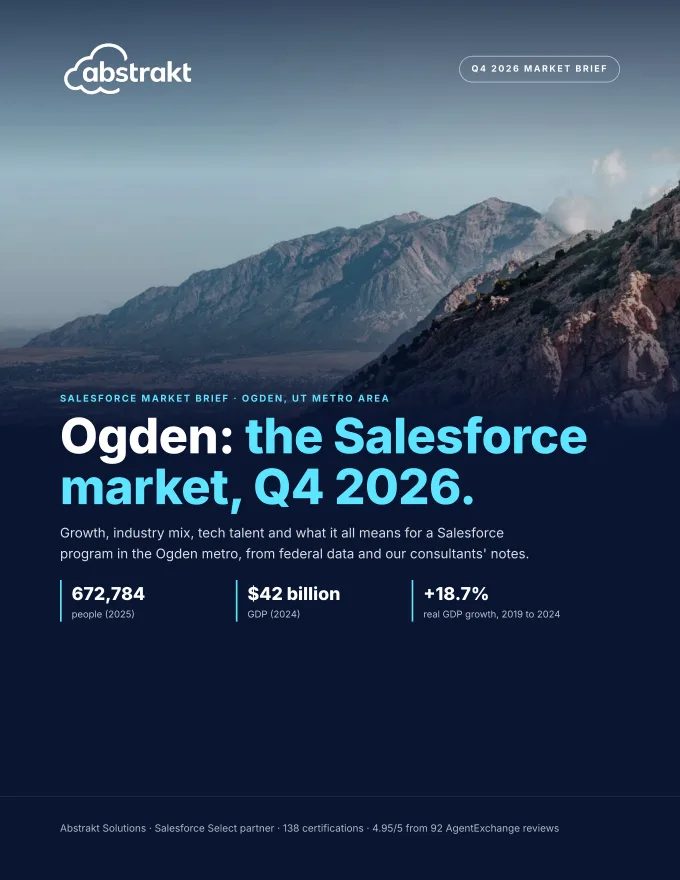
A free 22-page PDF with Ogden's growth ranked against 100 metros, its industry mix, tech wages and nearby markets. It is offered on the public Ogden page; send your customer there or get a copy for your own prep.
Get the Ogden brief →Co-sell with Abstrakt in Ogden
Working a Ogden account? Bring in a named consultant for discovery, scoping or a health check. We reply within 4 business hours.