What Data 360 is, and who this guide is for
Before you download
Data 360, which Salesforce called Data Cloud until October 2025, brings customer data from many systems together, resolves it into unified profiles and makes those profiles usable for segments, service context and AI agents. It can also query data where it already lives in a warehouse, without copying it.
The guide is for data, marketing and service leaders deciding whether a unified customer layer is worth building now. It explains Zero Copy, Data Spaces, Data Graphs, search indexes, Data Actions and Streaming Insights, covers industry use cases, and shows how to scope a first release around one decision rather than every available source.
Get the free Data 360 guide
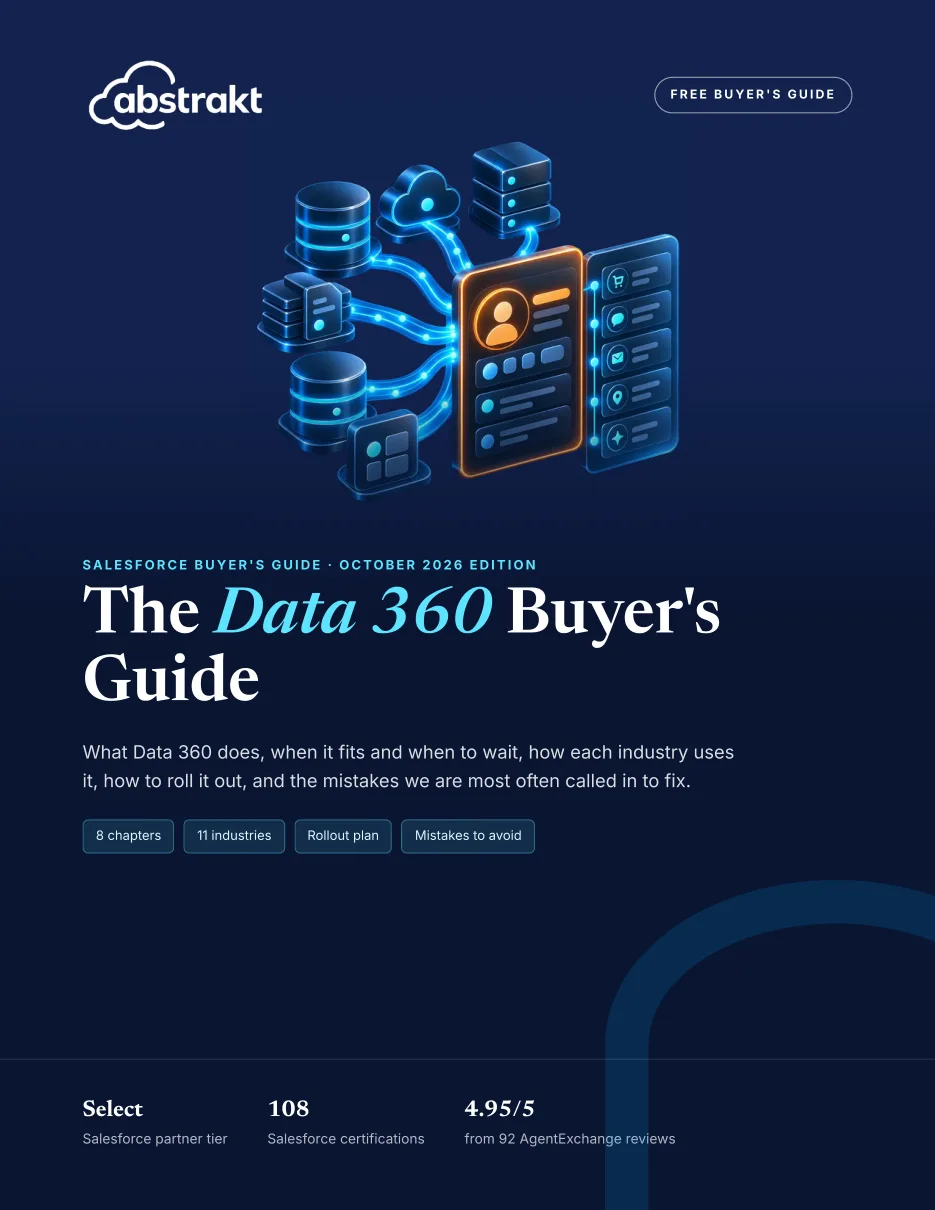
- 23 pages
- 8 chapters
- Free PDF
What's inside the Data 360 guide (8)
- 01
What Data 360 does
Zero Copy data federation, Data Spaces, Data Graphs, Search indexes for unstructured content, Data Actions and Streaming Insights.
- 02
When Data 360 fits, and when to wait
5 signs Data 360 fits and 4 reasons to wait or choose something else.
- 03
Data 360 by industry
hospitality, Mortgage & Lending, Private Equity, Retail & Consumer Goods, Health & Life Sciences and 6 more.
- 04
How to roll it out
Pick one activation target → Profile the source data → Map to the data model → Tune identity resolution → Monitor consumption and quality.
- 05
Mistakes to avoid
4 mistakes, from “Ingesting everything before choosing outcomes” to “Merging on weak identifiers”.
- 06
Questions buyers ask
5 questions, starting with “Is Data Cloud the same thing as Data 360?”
- 07
Results from our projects
3 Data 360 projects, summarized.
- 08
Next steps
Free assessments and how to reach a Data 360 consultant.
Worksheets you keep (4)
Fit scorecard
9 statements to tick, showing whether Data 360 fits your team now or later.
Decisions worksheet
4 Data 360 decisions with room for your answer and an owner.
Partner interview scorecard
5 questions to rate up to three Data 360 partners side by side.
30-day plan
Four weeks from reading the Data 360 guide to a written scope.
When Data 360 fits, and when to wait (7)
Good signs
- The same customer shows up in commerce, support, marketing and product systems under different identifiers.
- You want Agentforce agents to answer from order history, usage data or documents outside the standard Salesforce objects.
- Your data team already runs a warehouse and wants Salesforce to use it without maintaining another copy.
- Several brands or regions share Salesforce but must keep their audiences apart.
Reasons to wait
- Everything you need already lives in Sales Cloud or Service Cloud, where reports and flows can act on it directly.
- The goal is executive dashboards over historical data, which Tableau or CRM Analytics on your warehouse may deliver sooner.
- No one owns data quality yet, so unified profiles would amplify bad source data instead of fixing it.
The Data 360 rollout plan, in brief (5)
- 01
Name one activation target
Choose the single decision the first release will change, such as a suppression list or an agent’s grounding source, and work backward to the sources and fields it truly needs.
- 02
Profile each source
Check completeness, formats and duplicates before mapping anything. Shared email addresses, placeholder phone numbers and inconsistent country codes are what cause false merges later on.
- 03
Map to standard objects
Use standard data model objects wherever they fit, and document every mapping decision so future teams connecting new sources follow the same conventions.
- 04
Start identity rules conservatively
Review sample unified profiles with business users and loosen match rules only when evidence supports it. Reconciliation rules, which pick the winning value, deserve the same scrutiny.
- 05
Watch consumption and freshness
Track credit use by feature in Digital Wallet alongside profile counts and data freshness. Segments refreshed more often than anyone needs are a common surprise.
Data 360 mistakes we are called in to fix (3)
Connecting every source up front
Ingesting everything multiplies mapping work and consumption while delaying anything useful. One agreed decision keeps scope honest and gives stakeholders something concrete to judge.
Merging on shared identifiers
Household emails, shared business phones and test addresses can fold different people into one profile, and an agent may then show someone else’s history. Exclude known shared values and review merge samples regularly.
Adding consent at the end
When opt-outs are not mapped at ingestion, segments may reach people who already declined contact. Map consent in the first release and test suppression with real opt-out records before activation.
Decisions to make early (4)
| Copy or federate | Zero Copy queries warehouse tables in place, which suits curated data and strict governance. Ingesting gives Data 360 its own copy for unification and real-time use, and most designs mix the two. |
|---|---|
| Whether to partition with Data Spaces | Brands or regions with separate privacy obligations can be kept apart inside one instance. Decide this before segments and profiles multiply, because untangling them later is slow. |
| Which source wins | When two systems disagree on a value or a consent choice, reconciliation rules decide what everyone downstream sees. Treating the most recent explicit choice as authoritative is a sound default for consent. |
| Who owns the platform | A platform owner watches streams, errors and consumption, and a data steward reviews merges and profile accuracy. Assign both people before launch, not after the first incident. |
Questions to ask a Data 360 partner (5)
- What single outcome would you scope our first release around?
- How will you test match rules before profiles are used for activation?
- Which of our sources would you federate, and which would you ingest?
- How will consent from each source be mapped and tested?
- What will we monitor in Digital Wallet, and who receives the alerts?
Data 360 buyer questions (5)
Is Data 360 the same product as Data Cloud?
It is the same product under a new name. Salesforce renamed Data Cloud to Data 360 at Dreamforce in October 2025, and both names still appear in contracts and documentation. Ingestion, identity resolution, segmentation and activation were not changed by the rename, so existing plans carry forward.
Will Data 360 replace our data warehouse?
Usually not. The warehouse stays the home for history, finance reporting and data science, while Data 360 acts on customer data inside Salesforce. Zero Copy lets the two share data in both directions.
How does Data 360 help AI agents?
Data Graphs prepare a profile with its related orders, cases and events so an agent reads one structure quickly. Search indexes let agents ground answers in manuals and documents, with the source passage kept available for reviewers.
Can it use data from systems outside Salesforce?
Yes, through cloud storage, databases, web and mobile SDKs, APIs and prebuilt connectors, with MuleSoft covering systems that lack a native connector. Data quality and update frequency are the practical limits, not connectivity.
What can trigger action when customer data changes?
Data Actions fire when a profile crosses a threshold or an engagement score falls, launching a flow, a webhook or a notification. Streaming Insights calculate metrics continuously for time-sensitive cases such as abandoned browsing or repeated failed logins.
Who wrote it
Abstrakt Solutions is a Salesforce Select partner based in St. Louis that implements Data 360, with 138 certifications and a 4.95 out of 5 rating from 92 reviews on Salesforce AgentExchange (formerly AppExchange).
 Salesforce Sales Cloud
 Salesforce Service Cloud
 Salesforce Field Service
 Salesforce Marketing Cloud
 Salesforce Revenue Cloud / CPQ
 Salesforce Experience Cloud
 Salesforce Agentforce
 Tableau
 MuleSoft
 Gong
 Claude