What Salesforce Revenue Cloud / CPQ is, and who this guide is for
Before you download
Revenue Cloud covers the path from a configured quote to an order, a contract, an invoice and a renewal. Salesforce positions it as the successor to Salesforce CPQ, so many buyers are weighing two questions at once: whether the product fits their pricing, and how to move off the legacy package without disrupting renewals.
The guide is for revenue operations, finance and deal desk leaders. It explains the product catalog, pricing procedures, the configurator, order orchestration, usage-based invoicing and amendments, shows how product-heavy industries use them, and walks through a rollout that keeps pricing errors contained.
Get the free Salesforce Revenue Cloud / CPQ guide
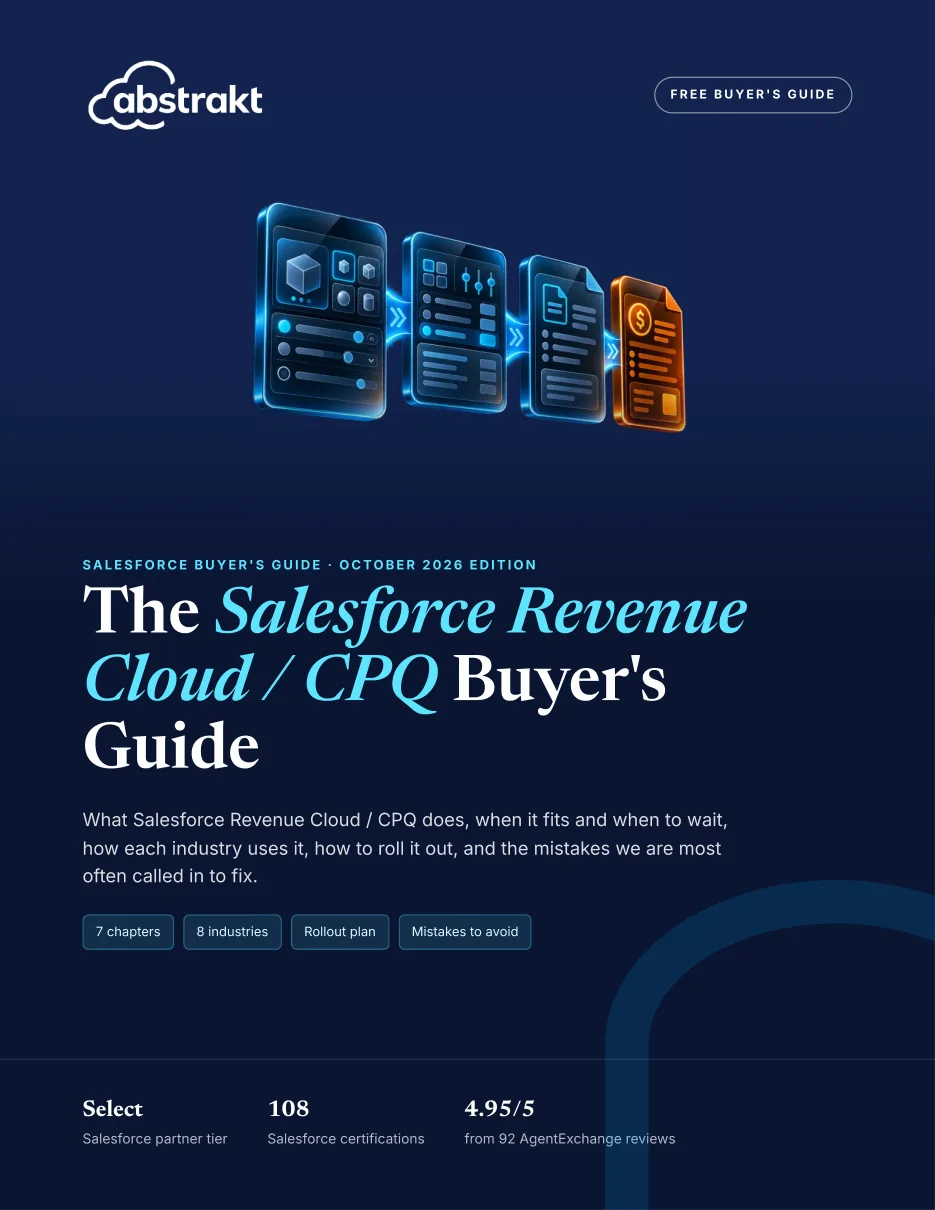
- 19 pages
- 7 chapters
- Free PDF
What's inside the Salesforce Revenue Cloud / CPQ guide (7)
- 01
What Salesforce Revenue Cloud / CPQ does
Product Catalog Management, Pricing Procedures, Product Configurator, Dynamic Revenue Orchestration, Consumption and Invoicing and Amendments and Renewals.
- 02
When Salesforce Revenue Cloud / CPQ fits, and when to wait
5 signs Salesforce Revenue Cloud / CPQ fits and 4 reasons to wait or choose something else.
- 03
Salesforce Revenue Cloud / CPQ by industry
Construction, Manufacturing, Professional Services, agriculture, energy and 3 more.
- 04
How to roll it out
Rationalize the catalog first → Document pricing as procedures → Map quote to invoice → Test with real deals → Cut over by segment.
- 05
Mistakes to avoid
4 mistakes, from “Rebuilding legacy CPQ line by line” to “Letting sales own pricing logic”.
- 06
Results from our projects
1 Salesforce Revenue Cloud / CPQ project, summarized.
- 07
Next steps
Free assessments and how to reach a Salesforce Revenue Cloud / CPQ consultant.
Worksheets you keep (4)
Fit scorecard
9 statements to tick, showing whether Salesforce Revenue Cloud / CPQ fits your team now or later.
Decisions worksheet
3 Salesforce Revenue Cloud / CPQ decisions with room for your answer and an owner.
Partner interview scorecard
5 questions to rate up to three Salesforce Revenue Cloud / CPQ partners side by side.
30-day plan
Four weeks from reading the Salesforce Revenue Cloud / CPQ guide to a written scope.
When Salesforce Revenue Cloud / CPQ fits, and when to wait (7)
Good signs
- Reps quote bundles where option compatibility matters, and orders keep bouncing back because they cannot be built.
- One quote needs to carry one-time, recurring and usage-based charges all the way through to billing.
- Finance wants every discount exception recorded with the approver and the reason.
- You run legacy Salesforce CPQ and need a migration plan while renewals of the old package are still available.
Reasons to wait
- Your catalog is a short list with occasional discounts, which standard Sales Cloud quotes and price books can handle.
- Every deal is a bespoke proposal put together by estimators, so configuration rules would rarely apply.
- Packaging still changes from month to month; stabilize it before encoding it in rules.
The Salesforce Revenue Cloud / CPQ rollout plan, in brief (5)
- 01
Clean up the catalog
Product management and finance agree which SKUs are live, which exist only for renewals and which can merge into one attribute-based product. Moving a bloated catalog unchanged recreates the old problems on new technology.
- 02
Write the pricing order in plain language
Document the sequence in which list price, agreements, tiers, promotions and manual discounts apply, and who may override each. Resolve disagreements before the build, because the system enforces whatever gets configured.
- 03
Trace quote to invoice
Follow a typical deal of each type through order, fulfillment, contract, invoice and revenue schedule, noting which system owns each record. Include a mid-term change and a renewal, since those expose integration gaps.
- 04
Rebuild last quarter’s deals
Re-create a handful of recently closed deals and confirm totals, terms and approvals match what customers actually received. Deal desk staff know which past quotes were exceptions.
- 05
Cut over one segment first
Move a single product line, region or team to the new quoting process while existing contracts renew in the old system until their next event. Plan how in-flight quotes are handled on cutover day.
Salesforce Revenue Cloud / CPQ mistakes we are called in to fix (3)
Translating legacy CPQ rules one to one
Revenue Cloud uses a different data model and pricing approach, so a literal copy carries old workarounds forward. Ask what each old rule was supposed to achieve, then rebuild that outcome the native way.
Designing pricing without finance
Discount stacking, rounding or proration that sales leadership likes can conflict with how revenue must be recognized. A finance owner should sign off on the pricing sequence before it is built.
Migrating the installed base last
When active subscriptions are loaded late and inaccurately, the first renewal cycle produces wrong quantities and missing co-term dates. Reconcile contracts early and rehearse a renewal on real accounts.
Decisions to make early (3)
| Where billing lives | If invoicing and revenue recognition stay in your finance system, the integration map defines which identifiers must match. If they move into Revenue Cloud, consumption and invoicing design comes into scope. |
|---|---|
| Approval thresholds | Set them by margin impact and product line, and decide where approvers can review in parallel. Chains that fire on every quote teach reps to hold deals until the last day of the quarter. |
| How mid-term changes are handled | Added seats, upgrades and cancellations should amend the existing contract with co-termed proration rather than create standalone deals. Confirm that works for your installed base before launch. |
Questions to ask a Salesforce Revenue Cloud / CPQ partner (5)
- Which of our current CPQ rules would you redesign rather than migrate?
- Who on our finance team needs to approve the pricing procedure?
- How will you migrate and reconcile our active contracts and assets?
- Which real deals will you rebuild in testing, and how will you compare the results?
- How will in-flight quotes and open amendments be handled on cutover day?
Salesforce Revenue Cloud / CPQ buyer questions (5)
Is Revenue Cloud the replacement for Salesforce CPQ?
Salesforce positions Revenue Cloud as the successor to Salesforce CPQ. It uses a different data model, so moving across is a redesign rather than an upgrade. Plan the move while the legacy package can still be renewed, and confirm the current dates with your account executive.
What is a pricing procedure?
It is a configured sequence of steps, such as list lookup, volume tiers, customer agreements and discounts, applied in a defined order. Because the sequence is explicit, finance and auditors can see exactly how any number on a quote was produced.
Can Revenue Cloud invoice for usage?
Usage billing is part of the design. Usage records are rated against each customer’s commitments, then invoiced alongside recurring charges, with drawdown balances and overages held in the same contract model.
What happens when one quote line becomes several fulfillment tasks?
Dynamic Revenue Orchestration breaks a sold order into the provisioning, shipping or activation steps downstream teams must complete and tracks each one, so sales can see whether what they sold was actually delivered.
Do we need to fix our catalog before starting?
At least in part. Attribute-based products can replace many near-identical SKUs, but only after product management and finance agree what is live and what is legacy. That exercise often uncovers products nobody has sold in years.
Who wrote it
Abstrakt Solutions is a Salesforce Select partner based in St. Louis that implements Salesforce Revenue Cloud / CPQ, with 138 certifications and a 4.95 out of 5 rating from 92 reviews on Salesforce AgentExchange (formerly AppExchange).
 Salesforce Sales Cloud
 Salesforce Service Cloud
 Salesforce Field Service
 Salesforce Marketing Cloud
 Salesforce Experience Cloud
 Salesforce Agentforce
 Data 360
 Tableau
 MuleSoft
 Gong
 Claude